Early on in the Covid-19 crisis, I became convinced that, despite all the global protocols, we in India should not be speaking of ‘social distancing’. The phrase has become familiar because of its reiteration by the prime minister and in hundreds of memes, jokes, WhatsApp forwards and Facebook posts, featuring pictures and videos of people standing in circles and squares marked on the street to buy essential items. But in a country like ours, where society has for too long been stratified hierarchically and privileged sections kept aloof from “lesser” breeds, don’t we have too much social distancing already?
What we really needed was physical distancing, not social distancing. The latter we have practised for too long as a culture. As retired IAS officer-turned-contrarian blogger Avay Shukla wrote not long ago, “the higher castes have for centuries made it a point to keep the lower castes at a safe distance: their water sources, toilets, houses, even cremation grounds have to be in a distant corner so as not to contaminate the twice-born....” These iniquities should make us vow to end social distancing, not advocate it.
But physical distancing is another matter: it is the key to resisting the contagion. The WHO recommends that we stay three feet away from each other to minimise the risk of contamination by a cough or a sneeze. But how is a country with one of the highest population densities in the world going to ensure that? Many of our slums and poor urban areas are estimated to pack people in at 80,000 to a square kilometre. There are 4.5 lakh Indians in jails, living cheek by jowl in conditions that could turn a minor term of imprisonment for pickpocketing into a death sentence by a pandemic. We cannot, literally or metaphorically, wash our hands off them.
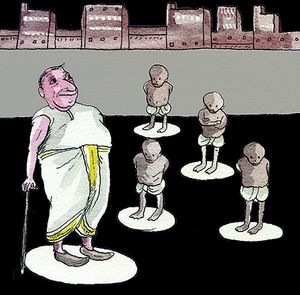 Illustration: Bhaskaran